
Existing Home Sales: Distressed Property Sales Propped Up, Revisions Were Huge
February 23, 2012 10:10 am
The existing home sales report released on Wednesday provided some disappointment. While the month over month number was better than

expected, some of that may be due to the large revision from the previous month. This revision game continues to cloud the real numbers in almost all categories of economic reports lately. We could speculate as to the reasons for the “errors” but will leave that for you to decide.
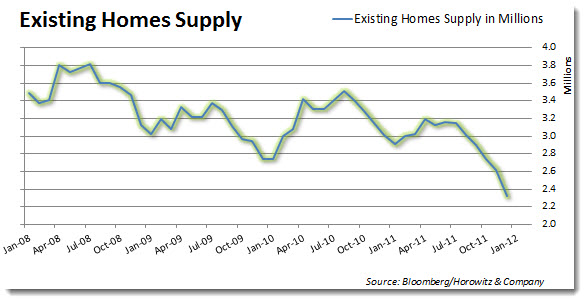
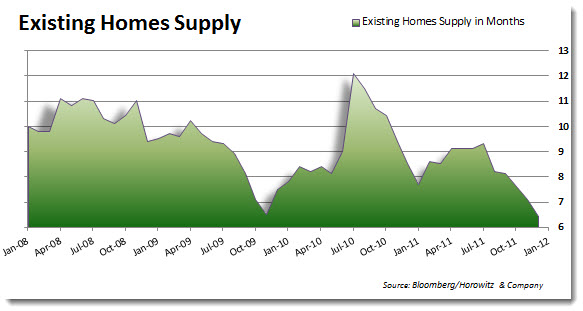
Still, the fact that inventory is clearing is a good sign and if we can convince builders to lay off the new homes development a bit, maybe pricing will start to stabilize further.
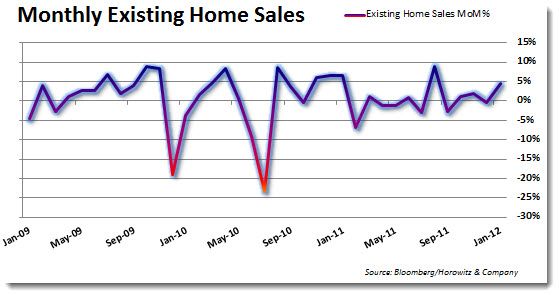
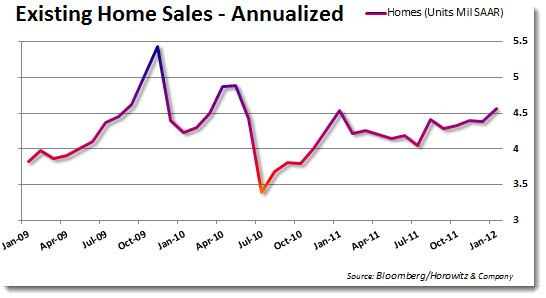
Feb. 22 (Bloomberg) — Sales of previously owned U.S. homes rose in January to the highest level since May 2010 as investors took advantage of lower prices to buy distressed properties. Purchases climbed 4.3 percent to a 4.57 million annual rate, less than forecast, from a revised 4.38 million pace in December that was slower than previously estimated, a report from the National Association of Realtors showed today in Washington. Distressed properties made up the largest portion of all purchases since April.
Almost one in four of all transactions was made by investors. That’s helping to clear the market of unsold properties and may stabilize prices. While the threat of more foreclosures risks slowing progress, housing may get a boost from gains in employment and mortgage rates that are near record lows.

2 Responses to “Existing Home Sales: Distressed Property Sales Propped Up, Revisions Were Huge”
Subscribe


Andrew Facebook
Andrew Twitter
Why Renters Rule U.S. Housing Market (Part 2): A. Gary Shilling
In making my case for continued housing weakness, I’ve emphasized the
negative effect of excess inventories on house sales, prices, new
construction and just about every other aspect of residential real
estate.
In housing, as in every goods-producing sector, excess inventories are
the mortal enemy of prices. Lower prices are needed to unload surplus
inventory, yet they also lead to the creation of more inventory by
anxious sellers. The plight of house sellers and the reluctance of
buyers are made worse by the realization that house prices can fall,
and are falling for the first time in 70 years.
There are about 2 million excess housing units in the U.S., over and
above normal inventory working levels. Before the housing collapse
began in 2006, housing starts and completions were volatile but
averaged about 1.5 million per year. So a 2 million excess is much
more than the previous annual average build.
Inventory Count
Many people think that house inventories are coming under control.
They point to the declines in inventories in relation to sales for new
and existing homes, yet that calculus doesn’t include the 5 million or
so housing units with delinquent mortgages or those in foreclosure,
much less the additional troubled loans that are probable in years
ahead.
http://www.bloomberg.com/news/2012-02-23/why-rent…
Enter text right here!To me the headline numbers are not the news, the revision is the real news. I'm not sure what the legal requirements are for the various reporting authorities to report fact as opposed to the fictions thay have been reporting over the past 3-4 yrs., but I would think that their record of revisions could easily substantiate beyond a reasonable doubt that they have been participating in a systematic fraud, a verifiable ponsi scheme at the highest level in this land. Will the FBI please stand up.