

Quick Elliott Wave Update on the S&P 500

February 8, 2010 12:35 pm

Our good friend Corey Rosenbloom, a master at technical analysis, has provided us with an update on the Elliott Wave for the S&P 500 Index. Some of the information may be new to you, so make sure to visit Afraid to Trade.com to get further education on the subject.

With a major inflection point possible here in the US Equity Indexes, let’s take a quick updated look at the current large-scale Elliott Wave Count in the S&P 500.

First, we must understand that the Elliott Wave method is one of many methods to analyze the markets, and it is only one input into the diverse strategies and indicators we can use.  This post will focus only on the Elliott Wave count of the past and present.

The first chart shows the the simple S&P 500 structure with a standard Fibonacci Retracement grid:
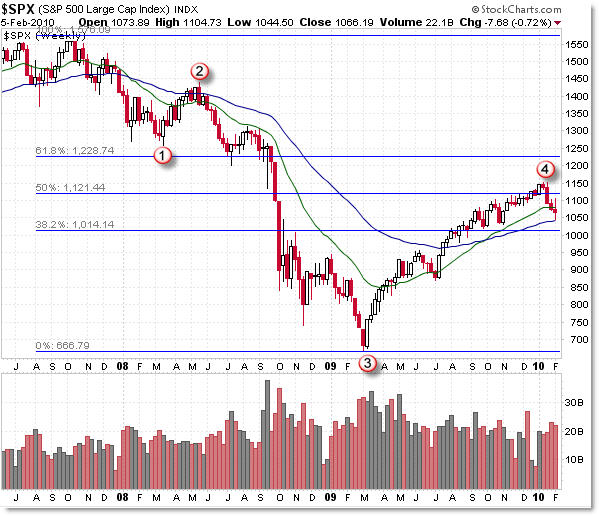
Starting with the October 2007 high of 1,576, we begin the count at wave 1 while Wave 2 is the retracement higher into the March 2009 high.  True to the theory, the third wave was the most powerful, beginning in May 2008 at 1,450 and ending at the March 2009 lows of 667.

Using that as a departure point, we would then consider the sharp rally from the March lows to the January 2010 highs as a powerful 4th wave that corrected a portion of the prior decline, ending at 1,150 which slightly overshot the 50% retracement at 1,121.  If indeed 1,150 holds as a top, then we would have increased confidence if not confirmation in this count.  The count you see above would be invalidated with any move above 1,200 (specifically 1,250, as the principle states that “Wave 4 cannot enter the price territory of Wave 1″).

The three-wave corrective structure complete with the lengthy negative volume divergence (meaning price continued to rally while volume declined during the rally, serving as a non-confirmation) increases the odds that we should interpret the rally – as powerful as it was – as a corrective phase rather than an impulsive one.  Generally, bull markets are seen to have increasing volume during the rally, not declining volume.

Now, let’s take a specific look at the wave count and a possible structural projection going forward if indeed this is the dominant count:
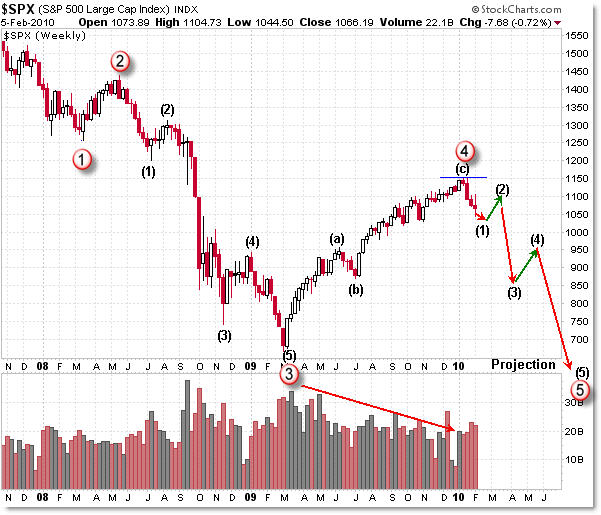

This chart isn’t meant to scare you, but is meant to take the logic of the potential count to the final degree, meaning if indeed we are truly seeing a Wave 4 corrective wave end, then we would expect a return to the final impulsive wave which would be expected to unfold in five smaller (called “fractal”) waves.  This is not meant to be a precise projection of timing or price, rather to underscore the expectation – according to Elliott Wave Theory – that a five-wave impulsive move would be the expected ‘pathway for price’ into the future.

Remember, Elliott Wave is only one way to interpret the market and is never intended to be the only way to interpret the market.

This bearish view would be significantly called into question with a break back to new recovery highs above 1,150 and officially invalidated with a break above 1,250.

Until either of these two events happen, this would be considered the “consensus” view using the Elliott Wave principle as a guideline.

Unfortunately, this viewpoint calls for a retest over the next few months or into 2011 of the March 2009 low of 667, and a final termination target slightly lower than that, but that is too far into the future to project accurately here.

As a matter of comparison, I wanted to show a similar pattern which looks eerily similar to the chart structure of today.

It’s the Dow Jones Index snapshot of the “Crash” of 1929 and then the recovery that slightly exceeded the 50% retracement just like today:
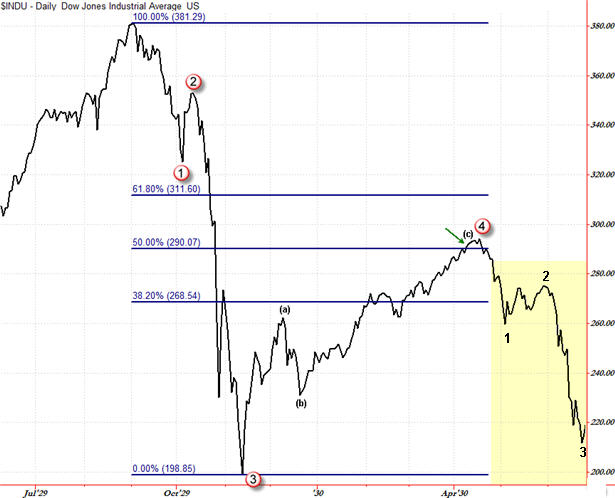
Not only is the initial decline similar to what we’re seeing now, but the rally was very similar to what we are seeing now in early February.

Unfortunately, price fell much lower than the 200 index level that comprised the Wave 3 bottom.  Let’s hope we don’t get a repeat performance on the way down should price continue falling.

I show this chart as an observation of “Hmm, that’s interesting” instead of saying “This is what will happen” because markets are different than they were 70 years ago, but it is interesting nonetheless to compare similar structures like this.

Continue watching the price to see how closely we follow the projected pathway, or – hopefully for investors – sidestep the warnings of lower prices ahead that the Elliott Wave theory is forecasting.

Corey Rosenbloom, CMT
Afraid to Trade.com

Sorry, No Related Posts.

8 Responses to “Quick Elliott Wave Update on the S&P 500”

  1. paul on February 8th, 2010 8:54 pm

    “Starting with the October 2007 high of 1,576, we begin the count at wave 1 while Wave 2 is the retracement higher into the March 2009 high”

    March 2009 high s/b May 2008 high.

  2. The 15 Hottest Read This Week on TDI : The Disciplined Investor on February 15th, 2010 11:44 am

    [...] 2. Quick Elliott Wave Update on the S&P 500 [...]

  3. Graham on February 23rd, 2010 2:17 pm

    Hi Corey Rosenbloom, why do you now favor idea that the March 2009 low is the end of a wave 3, as opposed to the end of a wave 5?

    http://www.valtinho.com/post/A-Beginners-Elliot-W…

  4. Joe D. on March 5th, 2010 8:12 pm

    I have to say I've come along way in my belief in technical analysis – I believe its useful for finding support/resistance of individual stocks especially over shorter time frames. I believe the idea of seeing frustrated longs in the charts is obvious. However, I'm skeptical that technical analysis can be taken this far – stochastic analysis applied to a gigantic index over many years.

  5. andre on September 24th, 2010 5:31 pm

    FUNNY!
    NOW THAT THE PREFERRED COUNT WAS INVALIDATED, HE DOES NOT UPDATE THE CHART ANYMORE!!!

  6. Corey on September 24th, 2010 6:33 pm

    Graham, That was indeed one of the larger potential counts – that the 3 labeled in this update was actually a 5. Post written on May 8: 2009:
    http://blog.afraidtotrade.com/sp500-elliott-wave-…

    Though the rally certainly doesn't have the feel of a Primary 1, it's within the possibilities.

    Joe, agreed that TA certainly does well in identifying/quantifying risk and opportunities on the lower timeframes as traders are becoming more reactionary to technical analysis and almost 'creating' some expected moves based on self-fulfilling prophecies.

    Andre,

    Keep in mind that Elliott Wave is mainly used as a forecasting tool and is not the only way to view the market. I find it helpful to know what if one dominant wave count is invalidated, then it lets us know that a key change has occurred, shifting biases. It's neat when alternate accounts align with a primary count, but eventually – as time goes on – counts must be disregarded as they are invalidated.

    In this case, the suggestion is that we are in a bull phase progression instead of the correction scenario, which serves to eliminate downside targets. But Elliott is only one component of market analysis and its use on the large scale certainly cycles in and out of popularity.

  7. vince campillo on September 26th, 2010 3:45 am

    The Elliott Wave is a powerful tool and I find very accurate in forcasting price movement, but in this case, I do not believe it is applicable. The 50% retracement is also very powerful, and I beleive this approach is best for the S & P. Why? Because March of 2000, it hit 1574, then fall to 767 Oct 2002, then from there, rose to 1586 Oct 2007. If you try hard, you might be able to decifer Elliott's theory, but it is not obvious. March 2009 it bottomed at 665, Elliott's in play here, but the high of 1216, April 2010 the 50% Retracement is also in play, at 1125, and it is hovering in that area. it may fall to that 50% Ret at 940, then head back up. As I read the indicators, the Daily, Weekly and Monthly ADX are all on the postive side, so hopefully it will lean toward the long side of the equation. This is the difficult part of trading, determining which theory works best as your guide.

  8. andre on October 12th, 2010 2:51 pm

    Corey, I agree with you. I have studied everything you can imagine, from Elliott to Fundamentals, Value Investing, technical analysis, and a lot of psychology to the markets.
    What amazes me is that the high chance count, which is bullish since march 2009 (confirmed by a lot of guidelines and rules from elliott) is never mentioned, neither here, nor at Mr Prechter website, nor even Neely-wave website. As time passes by, the "old-fashined" fundamental analysts and fund managers are making the right calls for the new bull market (which in my opinion already completed wave I up, and we are probably now on wave B of wave 2, in a flat correrction). It looks like 99% of elliotticians get "married" to easy with their own thinking and forget what the market is actually DOING and telling us…
    But … this is just my opinion and I wanted to share with you because your count 1 year ago was exactly the same as mine..

Got something to say?