
TDI Podcast 122: Mish – How Long Can This Rally Last?

August 16, 2009

Guest: Mike “Mish” Shedlock of Sitka Pacific discusses the bid on bonds and what that means for the markets. In addition, we review the price reductions that are being seen globally and how that will effect long term spending, earnings and unemployment. We also discuss the current CPI numbers and the outlook for the global markets.

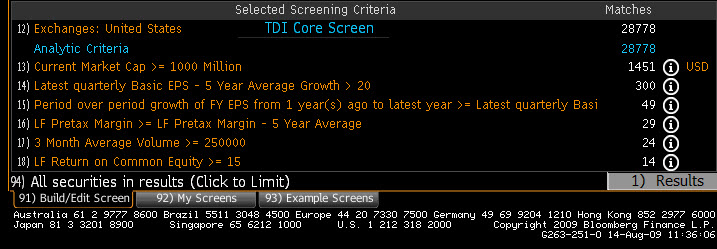
Andrew also provides a discussion on stock screening and how to use Quantitative investing process to your advantage. (See below for a sample of the screen results)

___

LISTEN TO PODCAST NOW | LISTEN @ ZUNE - @ iTUNES

___

This episode is sponsored by GoToMeeting. Try it free for 30 days

___

mish2

Mike “Mish” Shedlock is a registered investment advisor representative for SitkaPacific Capital Management. He is a regular guest on TDI Podcast and has helped thousands of listeners protect their money during these very turbulent financial times. As Mish tells us, “Sitka Pacific is an asset management firm whose goal is strong performance and low volatility, regardless of market direction.”

___

Click HERE for the QUANT Screen Results discussed in this episode.

(Click Image to Enlarge)
tdicorescreen

___

Stocks discussed in this episode: Medco Health (MHS), Express Scripts (ESRX), Campbells Soup (CPB), Peabody Energy (BTU), Consol Energy (CNX), Cerner (CERN), Flir Systems (FLIR), RalCorp (RAH), Walter Energy (WLT), Green Mountain Coffee (GMCR), SOHU.com (SOHU), World Fuel Services (INT), Olin Corp (OLN), Hexcel Corp (HXL) and many more…..

___

Click below for the 14 minute virtual tour
of the TDI Managed Growth Strategy

Related Posts:

  1. TDI Podcast 106: ZeroHedge and Mish-O-Nomics Guests: Mish Shedlock and ZeroHedge present views on the markets and the...
  2. TDI Podcast 131: Ritholtz On The Most Hated Market Rally EVER! Guest: Barry Ritholtz, CEO of FusionIQ has a frank discussion about the...
  3. TDI Podcast #120 – Recovery or Sugar High? Stock picks and the economy from this week and month are...
  4. TDI Podcast 139 – Getting Our Frank Curzio Fix Guest: Frank Curzio brings stock picks for this episode along with insight...
  5. TDI Podcast 137: 2 Stock Ideas, Dubai and Indicators Andrew flies solo this week with a discussion of the U.S. dollar,...

Comments

This website uses IntenseDebate comments, but they are not currently loaded because either your browser doesn't support JavaScript, or they didn't load fast enough.

15 Responses to “TDI Podcast 122: Mish – How Long Can This Rally Last?”

  1. Michael Riegger on August 17th, 2009 5:27 am

    Thanks for bringing Mish on, love hearing his thoughts.

  2. Dan on August 17th, 2009 3:54 pm

    At supermarket self-checkout lanes, you can't scan one package of meat and put two in the bag. The bag is on a scale and rejects that kind of trick. Supermarkets aren't stupid.

    I like Mish, but I keep in mind his heavy Libertarian viewpoint.

  3. NewsFlashr Editor’s Picks for August 17 | Afraid to Trade.com Blog on August 17th, 2009 12:21 pm

    [...] 4.  Andrew Horowitz of the Disciplined Investor interviews Mish of Mish’s Global Economic Trend Analysis with questions and commentary on “How Long will this Rally Last?” [...]

  4. NewsFlashr Editor’s Picks for August 17 | Penny Stock Trading System Blog on August 17th, 2009 6:40 pm

    [...] 4.  Andrew Horowitz of the Disciplined Investor interviews Mish of Mish’s Global Economic Trend Analysis with questions and commentary on “How Long will this Rally Last?” [...]

  5. Alex on August 18th, 2009 5:57 am

    Mish is basically advocating for a Great Depression 2.0 (spiralling deflation and unemployment, until we reach equilibrium way, way below where we are now), and that nothing should be done to try to ease the pain. I appreciate his insights but it's very hard for me to agree with his opinions.

  6. Foreign Treasuries Holders - Is China Selling? | The Disciplined Investor on August 18th, 2009 12:16 pm

    [...] report out yesterday on the foreign holders of U.S. Treasury securities. In the last TDI PODCAST, Mish and I spoke about the reasons why China needs to continue purchasing U.S. assets. In other [...]

  7. Deflation=Good on August 22nd, 2009 2:55 pm

    Alex and Dan need to reject keynesian (bubble) economics and embrace classical (austrian) economics, which is REAL economics. Both Henry Hazlitt (author of "Economics in One Lesson") and Von Hayek (Nobel Prize Winner and author of "Road to Serfdom") were classical (austrian) economists. You guys should read the book: "The Politically Incorrect Guide to: The Great Depression and The New Deal" by Robert Murphy. Ask yourself one question: "Would you rather have more purchasing power with every currency unit you have, or less purchasing power with more currency units?"

  8. Nom. Deflation=Good on August 22nd, 2009 3:57 pm

    I will concede Mish is not the greatest explainer in person. Andrew hasn't quite grasped the concept of "real" vs. "nominal". Let's say my salary is $100,000 last year (all things held equal – except federal reserve) doesn't mean I am able to purchase $100,000 worth of goods or services. If we had 3% price inflation, say since last year, I can "really" only purchase $97,087.38 today with that $100,000 that I made a year ago. Suffice it to say, when talking prices people generally speak about the nominal number not the real number. Mish and classical austrian economists talk about the "real number" which gives those who use it, by far, a more accurate analysis of the economy. When it comes right down to it, purchasing power is all that matters. What does it matter if I make $100,000 (all things held equal) if I can really only purchase $51,282.05 worth of goods or services since the inception of the federal reserve?

  9. Nom. Deflation=Good on August 22nd, 2009 3:58 pm

    To Coninue:
    That is exactly why NOMINAL PRICE DEFLATION IS GOOD. If nominal prices are allowed to deflate to "REAL PRICES/WAGES" the economy would finally reflect "reality", i.e. peoples and businesses purchasing power. People could then start to afford to purchase things. To conclude, it shouldn't matter how many dollars a person has, only the purchasing power of those dollars.

  10. Alex on August 25th, 2009 9:17 pm

    If nominal deflation is good, why wasn't Japan's situation in the '90s good? Why wasn't the Great Depression good? The reason is, because spending (i.e. the "multiplier") just stopped cold. The expectation of deflation feeds into spending less, because why buy something now when it'll cost less later? People will just hoard currency and hard assets until the expectation of deflation subsides; which of course leads to more deflation. That's what's called a deflationary spiral.

    As less people spend, output decreases. As output decreases, fewer jobs are required. As there are fewer jobs, there's more pain and suffering.

    For what it's worth, Austrian economics has its own huge boom and bust cycles, it's just that we've either forgotten about them or most of the economy was so concentrated in the hands of the few that most of the population couldn't really tell the difference.

  11. Chris on August 26th, 2009 2:47 pm

    "Would you rather have more purchasing power with every currency unit you have, or less purchasing power with more currency units?"

    It depends, if I have a lot of money then I want more purchasing power. If i don't have any money then I don't.

  12. Alex on September 13th, 2009 11:54 am

    There is a new type of ecomics being formed at the moment…….. something that will make history. There is no set of charts, stats algorythms that be compared to whats happening now. The last Great Depression, cannot be used to explain or avert a systematic collapse of epic proportions. We are going through a point in time that will be studied by all future generations.

  13. Adam on December 1st, 2009 12:24 am

    Alex are you talking about austrian economics?

  14. Lookout Ranch on January 6th, 2010 10:28 pm

    Bingo.

    It's a case of the cure being worse than the disease. I'm sure there's some moral satisfaction in watching the world economy crash and burn as a result of its excesses and mistakes, but I'd just soon tell the doctor "no thanks" if that's the cure.

  15. Love Poems & Quotes on January 31st, 2010 9:46 pm

    Austrian economics has to be what he's talking about!

Got something to say?