
Banks: “We Don’t Need No Stinkin’ Lending”
January 14, 2009
Is there any reason that the TARP is not called by its real name? Maybe the acronym TRAP is more fitting. It appears that the TRAP was simply designed to use taxpayer money to pay for huge trading losses. Right?
Now we are going to go through another round of dog-eat-dog on C-SPAN as Congress attempts to foil the plans of Treasury. Hopefully, there is a keen understanding that any pork additions will have to wait until the Obama Rescue. As that is already approaching $1 trillion, there is far more opportunity to bury an additional $100 billion or so of earmarks and general sweeteners.
The good news is that we have a world ready and very willing to work on a coordinated devaluation. Sometime I wonder whether it would be much easier just to agree that all currencies are valued the same and goods and services have a fixed price. This would end the charade that we have a strong dollar policy. ARGH! Just got a cramp I was laughing so hard at the idea of a strong dollar policy… Funny.
The real test of the idea of “CHANGE” will be how the next traucnh of the TRAP is handled. It would be a real confidence builder for investors if there is a real shake-up on the hill. REAL, not just some harsh words and finger pointing.
Someone needs to point out just how dissatisfied we are with the lack of oversight and planning.
Aaron Smith over at Dismal.com wrote an interesting piece that underscores the general failure of the TRAP to do anything more than line the pockets of the executives who willingly pushed the world economies on the the edge of disaster.
The principal impediments to an economic recovery are the hobbled financial system and what will likely be a prolonged period of heightened risk aversion. The crunch will eventually ease, but it will take some years for credit to flow freely again. The banking system has more losses to digest—from deteriorating consumer, commercial real estate, and corporate loans—and it will be difficult for banks to attract new private capital.
The unwillingness of private sector firms to lend to one another has made Fed liquidity actions necessary, including more aggressive forms of quantitative easing. In particular, the surge in excess bank reserves has not yet led banks to increase lending and expand their overall balance sheets. The Fed’s weekly bank asset and liability report shows a stagnant trend in loans outstanding, and weakness has been noticeable recently. After taking into account firms’ tapping of existing credit lines, which does not constitute new lending, and discontinuity in the data owing to bank acquisitions—for example, a saving institution that the FDIC took over and then sold—loans and leases on bank books have changed little since March.
On the other hand, the Fed’s balance sheet expansion through various lending windows has prevented an even more severe crisis. By lending to banks and buying commercial paper and now mortgages, the Fed is going where private investors fear to tread. The hope is that government actions will bolster confidence and thaw frozen markets. Though there is no evidence banks have stopped tightening lending standards, and though spreads on consumer and business debt have improved only tentatively, Treasury yields and mortgage rates have fallen sharply in recent weeks.
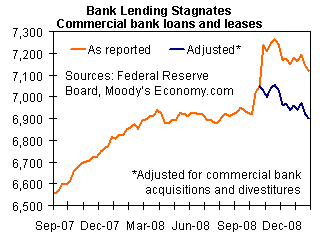
Private lending is not likely to turn up quickly—banks will not expand their loan books until their capital positions are fully restored. Even when lending resumes, lenders will demand substantial risk premia in the form of higher interest rates and fees, raising the cost of capital for household and corporate borrowers. However, the Fed’s actions should at least limit the amount of balance sheet contraction. Extremely wide credit spreads for even low-risk assets should eventually provide enough incentive for financial institutions to resume lending to creditworthy borrowers.
While we know that the banking industry needs to lend money to bring in revenue, it appears that they are smart enough to understand that the current climate is not working in their favor. Also, continuing/ongoing mass layoffs do not provide them with any relief from expanding delinquencies. How can we blame them? Business is business.
The only ones with their heads in the sand is the FED and the TREASURY. That doesn’t appear to show any signs of changing either.
DO NOT mistake that for sympathy for the bank or the banking system. It is just a reality…for now.
—

Sorry, No Related Posts.
Disclosure: Horowitz & Company clients may hold positions of securities mentioned as of the date published.Comments
6 Responses to “Banks: “We Don’t Need No Stinkin’ Lending””
Got something to say?
Subscribe


A, "TRAP" well stated. The idea of "forcing" a bank to lend, in effect create more debt to solve a debt crisis is amazing. Although it parallels the of idea of bringing down a heroin addict by giving them slightly less addictive drugs, until they can finally be free of the addiction. Cold Turkey can kill the addict.
I am most discouraged by seeing the executives getting salaries and bonuses paid with federal (taxpayer/debt) monies. They continue to get paid for running their business into the ground. Moral Hazard at its worst. When my first business failed, I still had to pay my debts and NOT draw a salary. Not so with these guys. To add insult to injury I was audited by the IRS after my first business failure. These guys get golden parachutes.
Trickle down economics seems to have flaws during times of recession. Although I prefer not to have Keynesian economics used, I guess this is the time for it. The millionaires and billionaires don't want to loose their moniker, so they are not going to trickle much down.
And just to think, the real pain is just starting to be felt and the Fed has few bullets left.
A new emerging solution is social lending, where people lend to each other without intervention or intermediaries. This whole mess was caused because of our thinking that a centralized entity and a "fits all" regulatory framework will keep things tight… well… it did not work. Let the power of the masses deal with it.
I found out about is on change.org. Check it out and vote:
http://www.change.org/ideas/view/solving_the_cred...
Hi Andrew, I appreciate all of the work you do on MSN and via your blog/website. I started listening to your blog every day in 2008 and it is a wealth of information. I do have one question or complaint that has gnawed at me since about last October. You have spent quite a bit of time (rightfully) complaining about the logistics and moral hazard of the 'bailout'. In fact, nearly all of the financial blogs and writers I read spend much of their time complaining about the bailout, but nary is their a voice who lays out a plan on what they would do. I think it would be helpful for you to spend significant time on a blog episode putting yourself in the position of Treasury Sectretary and Fed Reserve Chairman. What would you do, specifically, if you were in those positions? Perhaps you could address it like your blog episode that detailed what ailed the auto industry and then you made specific recommendations on what changes you thought would help the industry.
Keep up the good work!
–
Scott:
We have said OVER AND OVER… Just pushing money to it is not good. Let them fail. I am sorry that somehow that is not clear enough. The government needs to stop rewarding those that did this, harsh consequences and let them fail. It can’t get much worse.
Also, detailing it? Why? They do not listen to even those they respect. Why should I detail…? What is the point? All we need to do is to know how to invest to profit by their reckless behavior and keep out of trouble. Right?
Thoughts?
Andrew
Hi Andrew, I hope I don't come across as trying to pick a fight here because I do enjoy your work. To answer your question: "detailing it? Why? They do not listen to even those they respect. Why should I detail…? " That's a bit of a nihilist attitude, this is our government after all. You spend an entire podcast detailing the auto industry's problems and with all do respect I don't think they were on the edge of their seat tuning into that podcast scribbling down notes so there really was no point there either other then to engage and entertain your listeners (which you did!). Our financial crisis is probably the single biggest crisis of our lifetimes, so if you as a very engaging and intelligent financial mind spent time on reforms the auto industry should take (not just saying what they are doing wrong but brainstorming reforms) then I figured your listeners would enjoy hearing your thoughts on some things our government should be doing, not just what they are doing wrong.
I AM clear and agree that we should be letting the bad banks fail and the good banks survive so let me rephrase my question: What different actions, if any, should the Fed or Treasury be taking besides letting bad banks fail? I think we're in agreement on what they SHOULDN'T be doing, but should they be doing something for homeowners who will be foreclosed on, reforming the SEC, cut rates, should we be slashing taxes and upgrading our crumbling infrastructure, etc. I realize there are no easy answers I just thought your blog/podcast could spend some time moving beyond for a moment what we (the government) are doing wrong and exploring what the fed/treasury/congress/president should be doing (perhaps dedicate 1 podcast solely to this issue and then we can move on?).
Ultimately, the goal of your listeners is to make money so we don't need to spend every day breaking down alternative fiscal and monetary policy ideas that as you said probably won't be heard. But I think there would be interest among your listenership in exploring them for at least one episode.
By the way – an idea for a guest would be Mebane Faber. I'm a fan of his work, your recent interview with Tom Lydon made me think of Faber.
Scott…
i suppose I am frustrated. Not in denial. May be a bit of both. But, point well taken. I will work something up .. Or at least try.
Much thanks..
Andrew
PS. Are you sure they were not listening?