

Idiot Investing: Paul B. Farrell says Losing is Winning

December 31, 2008

OK, you hit a nerve. I can’t hold back any longer simply biting my tongue. I apologize in advance.

According to Paul B. Farrell, the money losing lemming of Marketwatch’s Lazy Portfolio strategy, it is a good thing to do nothing with your investments as they lose and lose big…

According to his latest brilliance:

And it’s so simple and easy. No Wall Street. No active trading. No stock-picking. Just buy and hold a well-diversified portfolio of three to 11 low-cost no-load index funds, all based on the Nobel Prize-winning Modern Portfolio Theory.

If that is not the most idiotic thing that I have heard in 2008, I don’t know what is. To actually come out and publicly boast that you have a winning strategy that entails no work and proud of the fact that you helped people lose more than 1/3 to 1/2 of their portfolio values takes some real nerve.

(See how we manage portfolios HERE)

What is it with these people anyway and why are they allowed to write such reckless dribble? I suppose that is is okay now to write about how easy it really is to work a Ponzi Scheme.

Mr. Farell, here is an idea for your next article: The Ponzi Portfolio: Simple! No Office. No Boss. No Research. Just tell people they are making money over and over because of a secret formula, all based on the Bernie Madoff Theory of investing. (At least Bernie made gains for his investors, even though they were fake)

And, you can keep telling everyone that you are beating the S&P, even though they are losing massive amounts of money. Ridiculous you say? No more than your Lazy Portfolio idea.

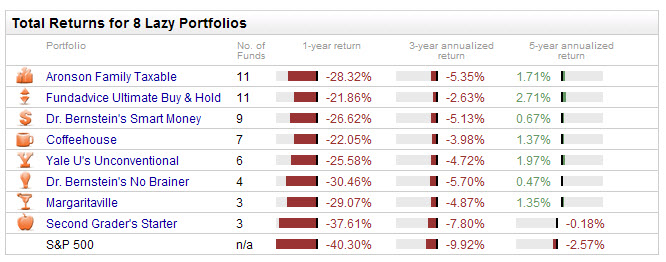
The article goes on to show just how absurd this Lazy Portfolio is:

So I asked the creators of the Lazy Portfolio what’s ahead. Well, nobody’s panicking: Not one is changing asset allocation for 2009.

Why change? If it is okay to lose 30% or so, what is the difference. Eventually they will get it right.

It is all about the S&P 500. Why? Seriously… Why? How about the thought of beating the benchmark of ZERO. I thought the idea was to make money when we invest, not be satisfied with simply beating an arbitrary index.

Yes, the Lazy Portfolios were down in 2008. But all eight Lazy Portfolios are beating the benchmark S&P 500 by anywhere from three to 18 percentage points. Plus the five-year averages for seven of the eight are in positive territory and the S&P 500 is not.

The real kicker (assuming you have not thrown up yet) is that the comparison is not apples to apples.  While it is fine to look at the S&P 500 as a comparison of a portfolio based on equities, there are several funds in your portfolios that invest in fixed income. If you were to look at those in relation to the S&P 500, how would they have compared?

Once again, a slight of hand to try to make their failure look good to an unsuspecting reader. Remember, even the 6′1″ fella looks short next to a 7′10″ gent. It is all a matter of perspective.

Mr. Farrell: RETIRE PLEASE!!!!! Then you can be lazy all day. Why should you work so hard at proving that you have found a winning formula, when you don’t?

Related Posts:

  1. Maximize Your Investing Potential Today only, Andrew Horowitz is teaching a free investing course at Cyber...
  2. 3 Ways to Make Money in a Downturn Here is some of the ideas that I discussed in a recent...
  3. TDI Podcast 142 – Identifying Winning Chart Trends Guest: Kevin Hoffmann and Andrew continue the discussion of QuantaFundaTechna and how...

Comments

This website uses IntenseDebate comments, but they are not currently loaded because either your browser doesn't support JavaScript, or they didn't load fast enough.

9 Responses to “Idiot Investing: Paul B. Farrell says Losing is Winning”

  1. VPro on January 4th, 2009 1:13 am

    Andrew, yeah, this is the same guy who a few weeks back listed 30 reasons why we'll be in a depression in 2010 or 2011, I don't recall which. If that's true, "lazy portfolios" will be worthless. I don't even bother looking past the headlines anymore and certainly don't take them seriously. You're right to address it and thanks.

  2. Andrew Horowitz on January 5th, 2009 4:27 am

    Re: VPro commented on Idiot Investing: Losing Less is Now Winning ? –

    V:

    It is really pathetic… Needs to be outed..

    Andrew

  3. Mark on January 5th, 2009 7:48 am

    I actually do commend Paul B. Farrell on his lazy portfolio approach to beating the S&P 500. If your goals are simply to beat the S&P 500 then the low cost index method is effective. However, I ask myself “Why is it that everyone uses the S&P as a benchmark?” Sure, it may be a good benchmark for determining the relative performance of a portfolio of U.S. equities, but isn’t that where the use should stop? I wonder where the use of the S&P as “the benchmark” started. Who is responsible for propagating its use? As we can see with the lazy portfolios, it’s not a difficult benchmark to outperform. Maybe the use of this index has been propagated by the “buy and hold” advisors.

    Andrew,

    What do you suggest investors use as a benchmark? If they don’t have a measure of relative performance, how should they measure their success as investors? Is a blend of indexes representing their asset mix appropriate? Or should investors forget benchmarks altogether and keep laser focused on the probability of achieving their financial goals?

  4. Mark on January 6th, 2009 3:33 am

    The search for a meaningful benchmark

    Maybe a benchmark of zero is a good starting point if we throw out the concept of relative returns and focus only on absolute returns. Not that it makes much of a difference in today’s market, but would a better starting point be the three-month T-Bill (or whatever we want to use as a risk-free rate)? From there shouldn’t there be a spread added to the risk-free rate depending upon the additional risk the investor is willing to take?

  5. Andrew Horowitz on January 6th, 2009 4:10 am

    Re: Mark commented on Idiot Investing: Losing Less is Now Winning ? –

    The S&P as a benchmark is kind of silly. Why is right! We could just go back to making money and make the benchmark zero. Or is that too simple?

    Andrew

  6. Andrew Horowitz on January 7th, 2009 3:02 am

    Re: Mark commented on Idiot Investing: Losing Less is Now Winning ? ==

    Mark…

    Sure, anything could work that does not dip below zero

    Andrew

  7. Mark on January 7th, 2009 4:05 am

    Still searching for a meaningful benchmark

    Unless I am missing something here, surely there must be more to it than that. If so, then why not use the 3-Month T-Bill as my benchmark? While the 10-Year total return ending 12/31/2008 on the 3-Month T-Bill of 40.44% is much better than the S&P 500 Total Return for the same period of -13.00%, that still barely keeps up with the CPI of near 30% for the same period. I doubt that you are suggesting any consistently positive benchmark is appropriate. Is it proper to focus only on absolute returns rather than relative returns? How should an investor gauge if they, or their advisor, are performing well? If we throw out the S&P 500 and blends of indexes matching their asset mix, what is left?

  8. Mark on January 7th, 2009 6:36 am

    Interesting: http://online.wsj.com/article/SB12312777854975860...

    Some things from this article sound familiar:
    Manage cash and go to it when there are no bargains
    Ignore benchmarks
    Don’t worry about underperforming through part of a market cycle

    Still, something just does not sit right. Is this market timing and if so, does market timing work in the long-run? Is it wise to hire an investment manager who has no shackles…especially without 100% transparency? How is an investor to compare the risk/reward ratios for managers without shackles?

    I apologize if I’m being a bit thick but deprogramming years of traditional financial “education” takes time.

  9. Idiotic Investing: Paul B. Farrell is Hunting Swans | The Disciplined Investor on January 20th, 2009 4:57 am

    [...] astounded by the blabber and blather that our dear old friend Mr. Farrell was presenting regarding Lazy Portfolios. Yes, those [...]

Got something to say?