

Dendreon – Is Provenge Snake Oil or Cure?
May 12, 2007
Dendreon Corporation (DNDN) took a huge fall the past few days after the FDA released an update to their “Approvable Letter”, asking for additional information regarding the efficacy of Provenge. This drug is, as most would say; “potentially revolutionary because it aims to teach the body’s own immune system to attack tumor cells.”
Shares have traded between $3.57 and $25.25 over the last 52 weeks, and had more than tripled since the FDA panel decision on March 29. By the end of the day on Thursday, share were resting at just over $5.00. A fall from a high place if ever there was one.
By their own account, Dendreon is at the forefront of introducing the first in a new class of therapy known as Active Cellular Immunotherapies (ACIs). The goal of Active Cellular Immunotherapy is to turn the immune system “back on” to elicit a specific and long-lasting response against cancer. Dendreon’s lead ACI candidate, sipuleucel-T, is for the treatment of aysmptomatic, metastatic, androgen-independent prostate cancer.
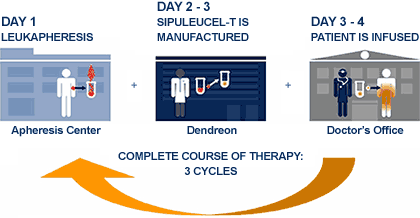
Quite different from other chemotherapies, this is not an outright “broad based attacker” that aims to rid cancer from the body by essentially destroying everything in its path. It is can be seen as the use of
one’s own “healthy” cells to working to clear the “bad” cells. Think of it as taking some of your own cells out for a walk, providing them with ingredients to help fight your cancer and then putting them back in your body. Then they spread the news on how to combat the bad cells allowing for the body to heal itself.
It seems that if any of the claims being made are even 50% accurate, there is more here than meets the eye. First, let’s examine the fact that the FDA advisory committee found that the mortality claims and the toxicity attributes of Provenge were low. In fact, they voted 17-0 on the side of Dendreon in their March 29th announcement regarding this issue.
In addition, there was reasonable statistical evidence to show that the treatment was beneficial to the test groups that had been participating in the company’s ongoing clinical trails. In that same announcement they stated that there was “substantial evidence” that Provenge was efficacious. Panel members voted 13-4 in favor of its efficacy. With all of this, why did the stock lose the majority of its value, falling $11.41, or 64.3 percent, to close at $6.33 the day the FDA requested additional information?
Here are some of the facts:
We know that, Dendreon is running a 500-patient clinical trial looking to see if Provenge has the ability to help those live longer who have had prostate cancer spread within their bodies. There are no known successful treatments available today for this specific cancer and this is one of the reasons that so much hope has been put into this trial. A good outcome would surely cause the FDA to approve commercial use.
Now it is believed that the earliest the latest trial data will become available is sometime in 2008. Realize while this is later than was first hoped for, it is not that long away and full results should be seen by 2010. The problem is that this DNDN may need to receive cash infusions in order to keep the trials going for longer than was anticipated and this will happen without revenue from sales. This could eventually create a hardship for the company, dilution to investors and could keep the share price down.
There has been a question raised about the trial’s efficacy by a select few who have stated that there may have been flaws in the efficacy results. At the heart of the question is the basis for the results. In past studies, short-term results have been the desired outcome for cancer drugs. Those drugs that have been used to fight off and hinder progression are looked at from a standpoint of disease velocity. Almost all treatments have been looked at in terms of the speed at which the either halt or slow malignancy.
This is precisely why the 1, 2 or 5-month addition to survival is statistically important up until now. Yet one has to question the basis of the underlying mechanism the FDA uses to provide approval for the distribution and sale of cancer related drugs. By no means do I have anywhere near the understanding and the experience as they do in this regard, but here is a thought: What if the current paradigm that is being used for the approval process is somehow flawed? What if the treatment that is being tested needs to be reviewed from a very different vantage point? What if this particular type of treatment can possibly help to bring about a change in the body’s own chemistry that will allow for an entirely different approach to the treatment of cancer?
Well, the truth is it still remains that the core benchmark is the extension of life. Even if Provenge is a remarkable medical breakthrough, in the end the patient must live long enough for it to work. If there is no significant increase, then the treatment will never be able to effectively work. That is of course there is some combination of life extension drug or treatment along with the new breed of Active Cellular Immunotherapies.
Obviously, it is a bit discouraging that the FDA is postponing their final decision from a shareholder’s standpoint. Realize that this is not the end of this story and there is likely to be much more to this story. From all of the information reviewed, it still seems to be a viable benefit to those who have participated in the trial. The company is down but not out by any means. With an aging population looking to find a cure, there is a good chance that there will be monies available to continue the research into this promising medical technology.
Sometimes we need to be in early with a Biotech company as the outcomes of a study can be suddenly beneficial to a shareholder, even when least expected. The current request by the FDA with regard to Dendreon seems to be a short-term distraction and it may just be the time to take a small position in the stock. Even after the announcement of a quarterly loss that was wider than anticipated and the scuttle that there may be upcoming layoffs, the stock managed to rally throughout the trading day on Friday.
The main attraction for the investor in DNDN is not this specific treatment. Provenge seems to be the tip of the iceberg that may become a sea-change in the biotech war against cancer. This particular treatment is the first of its kind and the possibilities are rather encouraging. This is the reason that this stock is seeing such interest. We need to look past the “noise” and wait until we see the statistically significant results before we abandon ship. This is just too important for too many people with a disease that until now is incurable.
Know this, there will be volatility. In the end, as this is right on the cutting edge of a medical breakthrough, it may be worth a bit of risk.
* As of this writing, clients of Horowitz & Company own shares Long of DNDN.

Sorry, No Related Posts.
Disclosure: Horowitz & Company clients may hold positions of securities mentioned as of the date published.Comments
One Response to “Dendreon – Is Provenge Snake Oil or Cure?”
Got something to say?
Subscribe


The Unreachable Availability of Provenge
Terminal patients are those who are not expected to live due to usually illness such as advanced cancer. If the patient has 6 months or less to live, those patients are considered terminally ill. Regardless, if a patient is terminal, they are without a cure or a tolerable treatment for their illness. Since such The patients will likely die in a short period of time, treatment options, even if unproven, are often desired by such patients. This is understandable, because at such a severe stage of illness, such as prostate cancer, possible extension of their lives with comfort is worth it to them, regardless of lack of evidence of proof of whatever treatment that may be advantageous to them regarding these issues. The FDA, however, claims authority on the treatment options of such patients, although that administration has proven itself over the years to be rather inadequate with its frequent drug recalls and black box warnings, and they do these things only under pressure from the public, usually. So, the FDA may not be an ideal judge regarding such issues as treatment options for very sick patients.
Prostate cancer is rather frequent, with between 10 to 20 percent of men predicted to acquire the disease during their lifespan, resulting in about 30,000 deaths a year from this disease. It is the third most common cancer one can acquire, and the United States has the most cases diagnosed n the world, which usually strikes men past the age of fifty. One million do have prostate cancer in the United States, and about thirty thousand will die from the disease each year. Furthermore, there are different stages of prostate cancer, and the more severe the prostate cancer cases are, the higher of what are called Gleason Scores will be, and the severe cases are the most difficult to treat, of course.
Yet innovation still exists in medicine. A few years ago, a small Biotechnology company called Dendreon was working on a conceptually new treatment for the worst prostate cancer patients, and this treatment therapy created by Dendreon was named Provenge. Provenge is the first immunotherapy biologic treatment for the progressed prostate cancer patients. Usually, these patients are unresponsive to usual treatment methods for prostate cancer, and are left with chemotherapy, specifically a hazardous drug called Taxotere, as their only treatment option at such a traumatic stage of prostate cancer. Understandably, most patients at this stage refuse treatment entirely, largely due to the brutal side effects of such chemotherapy treatments as Taxodere, which include cytotoxic side effects and haematological adverse events. The immunotherapy method developed by Dendreon requires the removal of white blood cells of the diseased patient and, after altered, are re-injected into this patient now designed to attack within the diseased body what is called PAP, which is on prostate cancer cells only. This treatment requires only three such injections in a period of six weeks. This results in life extension twice that of Taxodere, and Provenge is free of the discomfort of the only other treatment of Taxotere. The medical community and survivors of prostate cancer were elated and waited with great anticipation for access to this treatment method.
Fortunately, as the years passed, Provenge, by 2007, had convinced others of its safety and efficacy in its benefit for severe prostate cancer patients. This caused great joy to such patients and their families. Perhaps greater elation was experienced by the caregivers and specialists of such a disease, such as Urologists and other caregivers who treat such patients. While Provenge was on fast track status at this time at the FDA, as they at the time agreed with the benefits of this new therapy, the FDA panel recommended with clarity the approval of Provenge based on its proven and superior efficacy and safety that was demonstrated in its trials, as they announced in March of 2007. Lifespan extension of severe prostate cancer patients was twice as long with Provenge versus Taxotere, which is the only other treatment indicated for this stage of prostate cancer that had only superficial efficacy, and is free of the toxic effects of this chemotherapy agent.
Now for the bad news: With great shock and surprise, the FDA agency rejected the approval of this great treatment for very sick patients due to, they said, ‘lack of data’ in May of 2007. This contradicts their favorable opinion of Provenge weeks before delivering this terrible news. Especially when one considers the FDA Commissioner is a prostate cancer survival himself! Many found this ruling completely unbelievable.
Soon after this judgment was passed by the FDA, conflicts of interest were discovered by others. For example, a member of the FDA agency who was evaluating Provenge, Dr. Scher, was found to have a financial commitment to a future competitor of Provenge that was being produced by a company called Novacea, and this company had signed a co-promotion agreement with Schering to provide support for this similar prostate cancer drug treatment being developed by this company. Dr. Scher never disclosed this conflict during the approval process of Provenge. As it turns out, this anticipated prostate cancer drug made by Novacea was discovered to have serious flaws, and Schering pulled out of the agreement with Novacea. In addition to this incident and before May of 2007, baseless letters were anonymously delivered to the FDA stating negative qualities about Provenge that were without Merit and speculative claims about the treatment were fabricated in these letters, it is believed Oncologists were speculated to lobby and pressure the FDA not to approve Provenge due to anticipated revenue loss. Yet overall, the disapproval by the FDA of Provenge angered and saddened many, and a newly formed advocacy group called Care to Live filed a lawsuit against the FDA for their clear lack of etiology for not approving Provenge, as they should have, according to the data about the therapy last year.
Terminal patients, I surmise, desire comfort during their progressive disease that has placed them in the last chapter of their lives, and certainly should have a right to choose any treatment that possibly could benefit them. Clearly, because of their lack of desirable and beneficial treatment options, most are willing to assume any risks of unapproved, yet potentially and likely beneficial treatments such as Provenge. Because they have a terminal illness, these benefits provided by Provenge take priority over any possible safety issues of unapproved treatments for them. The controversy could be concluded by a terminal patient signing a waiver of some sort, perhaps, stating that they are responsible for the consequences of an unapproved treatment regimen such as Provenge. Yet the FDA, with reckless disregard and with deliberate intent, denied what likely was a great treatment therapy for these very ill patients. Several have concluded that the FDA ultimately harmed others more by not approving Provenge, or offering any valid explanations explaining their action. Thier action was irrational, as one considers the agreement of the FDA and others regarding the need of the benefits provided by Provenge for the sickest of the sick with advanced prostate cancer.
The FDA does in fact presently have the ability to grant what is called conditional approval for such treatment methods as Provenge at this time, and why they have not remains completely unknown. What is known is that they are accelerating and worsening the illness, an illness the FDA pledged to protect so long ago. So now the FDA appears to be a bought, corrupt, and incompetent administration without loyalty and dedication to the public and its health, but with what appears to be overt collusion with venture capitalists and corporations. This needs to be corrected in any way possible for the lives of others- regardless of their own present health state today. Because of the FDA’s flaws in the past regarding drugs taken off the market along with increasing black box warnings of other drugs, which happens often with both, the individual should be the deciding factor in such matters of deciding thier treatment course presently, along with their health care provider, due to this unreliable administration called the FDA.
“Facts do not cease to exist because they are ignored.” — Aldous Huxley
Dan Abshear